Speak Math. Every AI Listens.
The AI Symbolic Protocol (AISP) turns fuzzy natural-language instructions into precise mathematical notation — the universal grammar that every modern AI already understands natively.
Zero ambiguity. Consistent results. Across every frontier model.
An independent explainer for bar181's aisp-open-core — built to take you from "never seen it" to "ready to implement".
01
Your AI heard you. But did it understand you?
Why does this exist?
You wrote a clear instruction. The AI responded confidently. And then you discovered it did something slightly — but critically — different from what you meant.
Ambiguous phrasing is invisible to you but deafening to an AI. "If the user is admin, allow access" — allow access to what? Now? In this session? To everything? The AI fills the gap with its best guess. And on the 41% of runs where it guesses wrong, you get a silent error masquerading as a confident success.
Across a ten-step automated pipeline, that mismatch compounds relentlessly. Industry data shows natural-language AI pipelines succeed only 59% of the time. Almost half your automated work fails — not loudly, but quietly, with plausible-sounding outputs that diverge from your intent.
The root cause is not the AI. It is the medium: natural language was designed for humans who share implicit context. AI systems must infer what you left unsaid — and different models, on different days, infer different things.

02
A universal grammar AI already speaks
What does it actually do?
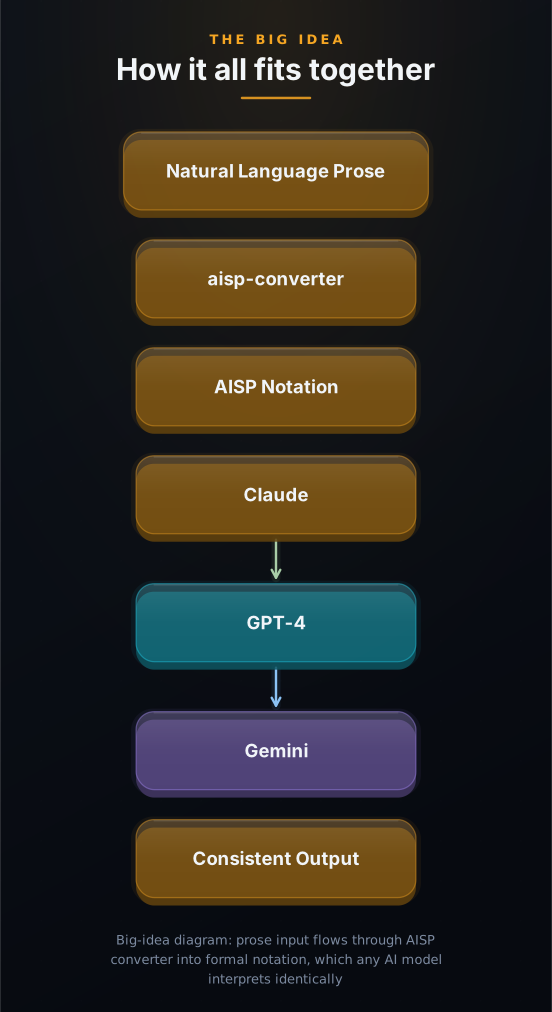
The AI Symbolic Protocol — AISP — is a formal notation standard that replaces prose instructions with mathematical symbols that have exactly one interpretation, universally shared across every frontier model.
"For all users who are admins, grant access" becomes a precise logical statement: for-all u in Users, if admin(u) then allow(u). Written using the standard mathematical symbols that every frontier AI has learned during training, this expression means exactly the same thing to Claude, ChatGPT, Gemini, or any future model. Not approximately — exactly.
AISP defines 512 official symbols across 8 categories: quantifiers (for-all ∀, there-exists ∃, unique ∃!), logic operators (implies ⇒, iff ⇔, and ∧, or ∨), set operations (element-of ∈, subset ⊆, union ∪), type domains (natural numbers ℕ, real numbers ℝ, strings 𝕊, booleans 𝔹), and more. Documents follow a five-block structure — metadata (Ω), types (Σ), rules (Γ), functions (Λ), and an evidence block (Ε) carrying a measured quality score.
No training required. No special tools needed. Copy, paste, and every modern AI reads it natively — because every modern AI was trained on the world's mathematical literature. The symbols for "for all," "implies," and "defined as" appear throughout that literature with one consistent meaning.
| Natural Language | AISP Notation | Ambiguity |
|---|---|---|
| "Define x as 5" | x≜5 | 0% |
| "For all users, if admin then allow" | ∀u∈Users:admin(u)⇒allow(u) | 0% |
| "There exists a valid solution" | ∃x:valid(x) | 0% |
| "A implies B" | A⇒B | 0% |
03
The insight: every AI already speaks math
Why is it elegant?
Here is the elegant move at the heart of AISP: it exploits what AI already knows.
Every large language model — the class of AI systems that includes Claude, ChatGPT, Gemini, and their peers — was trained on billions of pages of scientific literature, textbooks, and formal proofs. The symbols for 'for all,' 'there exists,' 'implies,' 'function,' 'defined as' appear throughout mathematics, logic, and computer science with one consistent meaning. Every frontier model has internalized that meaning into its weights.
The pilot evidence confirms it: Google Gemini and OpenAI's flagship model (both frontier AI systems from independent vendors), given AISP documents with no glossary and no examples, independently recovered every semantic decision point — scoring 72 out of 72 (100%). They did not just translate symbols word-for-word; they interpreted them into their conventional engineering register. The 'translation gradient' is real: AISP symbols preserve meaning while adapting form for the audience.
AISP (the AI Symbolic Protocol) is not a new protocol that AI must be taught. It is the discovery that formal mathematical notation was already the universal protocol — AISP simply formalizes the convention, defines the 512-symbol vocabulary, and gives you tools to convert prose to it and validate the quality of the result.
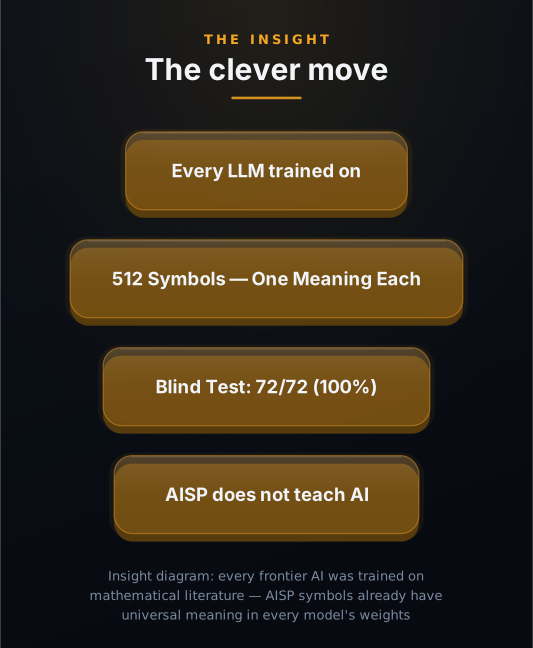
AISP does not teach AI a new language. It formalizes the one every frontier model already learned during training — and proves it with a 72/72 blind test.
04
How it works: from prose to proof in three steps
How is it built?
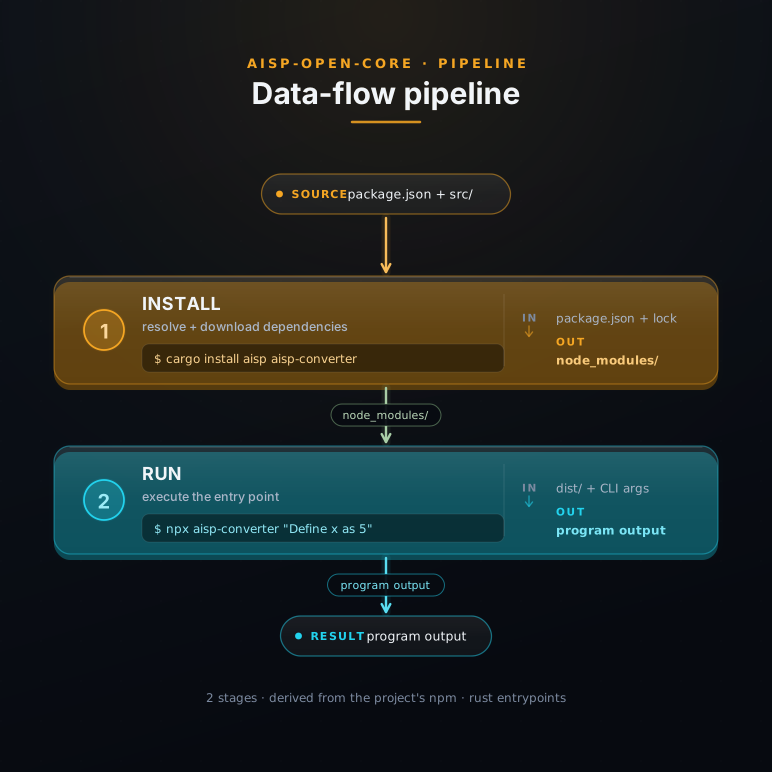
The AISP toolchain is a two-tool pipeline. The converter turns prose into notation; the validator scores and grades the result.
Step 1 — Convert. The aisp-converter (npm or Rust) parses your prose and looks up each phrase in the AISP Rosetta Stone table — a bidirectional mapping between English phrases and formal symbols. Direct matches convert deterministically, with no AI involved. For ambiguous constructions, an optional LLM fallback fills the gaps. Output selects one of three tiers: Minimal (simple variable definitions), Standard (quantified rules and type definitions), or Full (complete five-block specification with proofs).
Step 2 — Validate. The aisp-validator measures semantic density (delta) — symbols per token, weighted by information content — and assigns a quality tier: Platinum (delta above 0.75, for production specs and AI-to-AI contracts), Gold (above 0.60, for high-quality documentation), Silver, Bronze, or Reject. The document's own evidence block carries this grade, making it self-validating. In CI/CD, you can enforce a minimum tier with --min-tier gold.
Step 3 — Prompt. Paste the validated AISP block into your AI prompt as context. The model reads it as a formal specification — no extra instruction needed. The result is consistent across every model trained on scientific literature, from now until the next generation of models.
05
Could this be for you?
Could I use this?
AISP is useful any time you need an AI to follow instructions precisely and reproducibly — especially in pipelines, multi-model environments, or safety-critical contexts.

1 AI Agent Pipelines 97x success
A 10-agent workflow where each step passes instructions to the next. With natural-language prose, errors compound across steps: only 59% success. With AISP formal notation, each hand-off is unambiguous — 95% success. That is the difference between a pipeline you trust and one you constantly babysit.
- Before AISP:
- 59% pipeline success — 4 in 10 runs fail silently
- With AISP:
- 95% pipeline success — consistent, reproducible results
2 API Contract Generation Zero-drift specs
Express a REST API endpoint in AISP — input types, output types, error cases — and any AI generating code from that specification produces the correct function signature, the correct error handling, and the correct types. Every time. Regardless of which model, which version, or which day.
getUser ≜ λid.(∃u:User:u.id=id) → u | ¬found → 4043 Multi-Vendor AI Teams Cross-model consistency
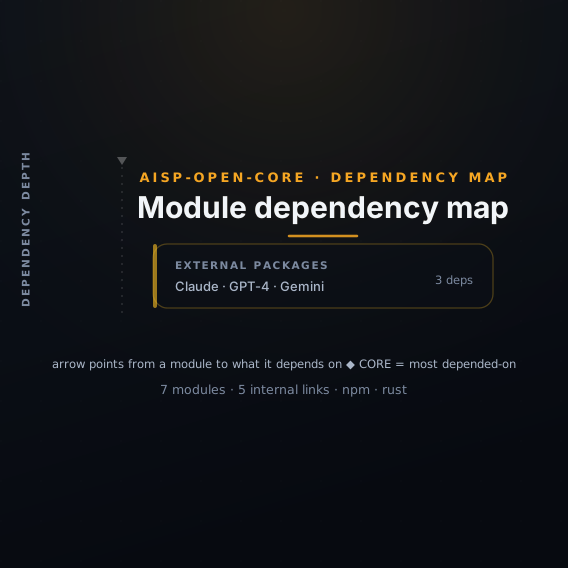
Your team uses Claude. Your client uses GPT-4. Your CI pipeline uses Gemini. With prose specifications, each model brings its own interpretation. With AISP, "for-all authenticated users, allow data access" is a mathematical statement with one meaning — the same to all three. Ship once, deploy everywhere.
4 Requirements Engineering Machine-verifiable
Product requirements written in AISP are machine-verifiable: you can check that a rule was implemented, not just hope it was interpreted correctly. The aisp-validator's CI integration lets you enforce a minimum quality tier on every specification, catching ambiguity before it reaches the model.
5 Safety-Critical Constraints Provable safety
A formally stated safety rule — 'for all inputs x, if dangerous(x) then do not deploy(x)' — is a constraint an AI can check against its outputs, not a guideline it might misread. AISP's proof-carrying documents let you attach formal safety proofs to specifications, making the safety property part of the contract.
06
Get started in 30 seconds — no installation
How do I start?
AISP runs on npx — zero install required. Just Node.js 18+, and you are ready to convert and validate.
# No installation required
npx aisp-converter "For all authenticated users, allow data access"
# Output: ∀u:auth(u)⇒allow(u)

npx aisp-validator validate spec.aisp
# Output: ✓ VALID (Gold tier, δ=0.64)- Run triage: npx aisp-converter --triage "your prose" — AISP recommends the right tier (Minimal / Standard / Full) and explains why. You see the complexity level before committing.
- Convert to AISP: npx aisp-converter standard "For all authenticated users, allow data access" — your prose becomes precise notation: ∀u:auth(u)⇒allow(u). Deterministic, no AI needed for direct matches.
- Validate and grade: npx aisp-validator validate spec.aisp — you see a tier badge (◊⁺⁺ Platinum / ◊⁺ Gold / ◊ Silver / ◊⁻ Bronze / ⊘ Reject) and a density score. Add --min-tier gold to your CI/CD for automated quality enforcement.
- Paste and prompt: Copy the AISP block into your AI prompt as context. Give it to Claude, GPT-4, or Gemini. Observe consistent, correct output — every run, every model. That is the whole loop.
07
Take the knowledge with you — AI-ready pack
Does my AI get it too?
This explainer ships a downloadable AI knowledge pack: the AISP specification embedded as a vector knowledge base that your own AI assistant can search, reason about, and use to answer questions.